
Addressing Rural Adolescent E-Cigarette Use
Articles
Treatment
Transcript
E-cigarette use among rural youth poses health risk
E-cigarettes, also called vapes, were the most commonly used tobacco product among middle and high school students in 2023, with 7.7% of students currently using e-cigarettes (4.6% of middle school students and 10% of high school students).¹ The aerosols in e-cigarettes can contain harmful chemicals as well as nicotine, which is addictive and can harm brain development in adolescents and young adults.² Aggressive advertising and attractive flavors have contributed to the use of e-cigarettes among youth.³ Many young people who use e-cigarettes also use other tobacco products such as cigarettes or cigars, with one in three high school students and one in two middle school students who vape using other products in 2020. Despite rates of use, most young people who vape want—and have tried—to quit. In 2020, of students currently using e-cigarettes, 63.9% reported wanting to quit and 67.4% reported trying to quit in the last year.⁴
Addressing e-cigarette use in collaboration with rural school districts
UR Medicine Recovery Center of Excellence is developing programs and resources to address e-cigarette use in rural schools and communities. The center is adapting an existing curriculum with information from a listening tour with rural adolescents and adults. Two distinct tracks of educational programming are being developed:
An alternative-to-suspension program for students facing disciplinary action for using e-cigarettes in school that focuses on treating nicotine addiction and is designed by and for the community
A flexible, self-paced educational curriculum for providers in rural areas (primary care providers, family medicine physicians, pediatricians, and school nurses) to learn about nicotine replacement therapy and treating nicotine use disorder in youth
The program will be developed and implemented in close collaboration with rural communities:
Phase 1: Host focus groups in rural areas of New York State.
Phase 2: Apply learnings from focus groups to modify our existing curriculum and develop professional educational materials.
Phase 3: Partner with school districts to pilot the treatment program, evaluate program effectiveness and feasibility, and make adaptations as needed before expanding the program to other school districts.
Phase 4: Launch an educational series on the center’s website for free continuing medical education (CME) credits and create a toolkit for national dissemination based on the materials created and lessons learned during project implementation.
Our pilot program in rural schools
The goal of our vaping-cessation program in schools is to provide information, counseling, and support to help students quit vaping. Over seven weeks, students meet with a family medicine clinician from University of Rochester Medicine on a secure virtual meeting platform. Meetings address the following topics:
Harmful effects of smoking/vaping
Myths of big tobacco, nicotine addiction, and nicotine replacement therapy
Managing cravings
Overcoming obstacles
How to deal with stress
Students who are moderately or severely dependent on nicotine may also be offered prescription medication. Nicotine replacement therapy can support students’ efforts to quit by helping them overcome nicotine cravings.
How does the program work?
Students meet with a physician or nurse practitioner for five sessions over seven weeks. There is a one-hour introductory meeting, followed by four half-hour sessions. The first three sessions are weekly, followed by two sessions held every other week.
Appointments are scheduled during school hours by a designated school staff member. School staff make sure students have access to a laptop with internet service and can attend meetings in a secure, confidential location.
At the sessions, students talk with one of our clinicians about their e-cigarette use. A quit plan is developed using behavioral health change strategies. Prescriptions for nicotine replacement therapy may be written when appropriate.
Students are asked to complete a survey about their e-cigarette use and their confidence in their ability to quit before they begin, one month after they complete the program, and seven months after they complete the program.
Who is eligible to participate?
We are currently partnering with several schools in rural New York State to pilot the program. Any student attending these schools can participate, and students of any age are welcome. The only qualifying factor is being someone who is interested in receiving clinical support to help quit vaping.
Some students choose to participate simply out of interest, while others may choose to participate if they have violated the school's vaping policy and are offered the option to complete the program rather than face disciplinary action from their school.
Does it cost to participate?
No, these virtual appointments are absolutely free of charge.
How was the program developed?
In modifying this program for our rural partners, we collected feedback from students, parents, and school staff at focus groups held in rural New York communities throughout the 2024-2025 school year. The preferences and recommendations shared by teens and adults who participated have shaped all aspects of the program.
Contact us
If you are interested in learning more about our school program, would like to share your experiences related to e-cigarette use in schools, or have other questions, please reach out to Dr. Holly Russell (Holly_Russell@URMC.Rochester.edu) or Erin Mattison (Erin_Mattison@URMC.Rochester.edu).
Our team
Holly Russell, MD, MS: Family medicine physician; project lead and developer of the Vape Escape program
Erin Mattison, MPH: Project manager
Shivani Sockanathan, MD: Family medicine physician; consulting faculty
Kristin Palladino, NP: Family nurse practitioner; consulting faculty
References
[1] Birdsey, J., Cornelius, M., Jamal, A., Park-Lee, E., Cooper, M. R., Wang, J., Sawdey, M. D., Cullen, K. A., & Neff, L. (2023). Tobacco product use among U.S. middle and high school students - National Youth Tobacco Survey, 2023. Morbidity and Mortality Weekly Report, 72(44), 1173-1182.
[2] U.S. Department of Health and Human Services. (2016). E-cigarette use among youth and young adults: A report of the Surgeon General, pp. 6-7.
[3] Centers for Disease Control and Prevention (CDC). (2024, May 15). Why youth vape.
[4] CDC. (2024, May 15). E-cigarette use among youth.
References for video
Hartmann-Boyce, J., Chepkin, S. C., Ye, W., Bullen, C., & Lancaster, T. (2018). Nicotine replacement therapy versus control for smoking cessation. The Cochrane Database of Systematic Reviews, 5(5), CD000146. https://doi.org/10.1002/14651858.CD000146.pub5
Hsia, S. L., Myers, M. G., & Chen, T. C. (2017). Combination nicotine replacement therapy: Strategies for initiation and tapering. Preventive Medicine, 97, 45–49. https://doi.org/10.1016/j.ypmed.2016.12.039
Hurst, D. (2015). Nicotine lozenges and behavioural interventions may help smokeless tobacco users to quit. Evidence-based Dentistry16(4), 104–105. https://doi.org/10.1038/sj.ebd.6401129
Prochaska, J. J., & Benowitz, N. L. (2019). Current advances in research in treatment and recovery: Nicotine addiction. Science Advances, 5(10), eaay9763. https://doi.org/10.1126/sciadv.aay9763
Siu, A. L., & U.S. Preventive Services Task Force (2015). Behavioral and pharmacotherapy interventions for tobacco smoking cessation in adults, including pregnant women: U.S. Preventive Services Task Force recommendation statement. Annals of Internal Medicine163(8), 622–634. https://doi.org/10.7326/M15-2023
Wadgave, U., & Nagesh, L. (2016). Nicotine replacement therapy: An overview. International Journal of Health Sciences, 10(3), 425–435. https://pmc.ncbi.nlm.nih.gov/articles/PMC5003586/
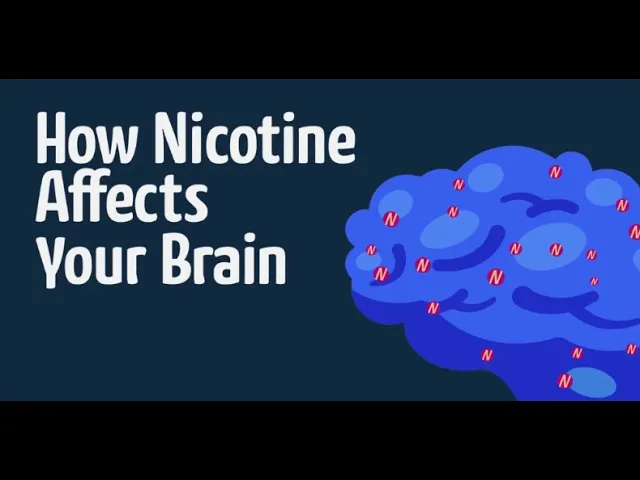
Description of video imagery
After the title, How Nicotine Affects Your Brain, a person's head appears. Circular Ns, representing nicotine, stream into the brain. The figure puffs on an e-cigarette, and Ns spread throughout the brain. Blue circles emit from nicotine molecules into the brain. A dopamine starburst appears. Icons representing concentration, memory, mood appear. A blue figure does a happy dance. Rs representing receptors absorb multiple Ns for nicotine. The figure vapes while nicotine floods the brain. Weeks pass on the calendar. The figure shows nausea, irritability, headache, and suffering. The screen fills with nine head figures vaping. The brain appears on screen with nicotine molecules dissipating. Helpful resources for quitting nicotine appear. A link to the project website and references are provided.
