

Program Overview
Postoperative Pain Management in Rural Communities
This program overview was provided to key stakeholders and project champions in the Southern Tier and Finger Lakes regions in New York during the planning phase of the Postoperative Pain Management in Rural Communities project.
We hope it will serve as a helpful overview of project goals, processes, necessary staff, and expected outcomes that other sites and organizations can adapt in implementing this project to their specific rural needs.
Aims
Adopt evidence-based benchmarks, best practice guidelines, and standards for appropriate opioid prescribing.
Educate patients on multimodal analgesia, risks of postoperative opioid use, and appropriate disposal methods for opioids.
Measurables:
- 1.Optimize patient care: providing adequate pain management
- •An important component of ensuring successful implementation and project maintenance is ensuring we are measuring the impact of our project's tools and materials.
- •We use an adapted CAMI for providers as well as a patient survey to measure the goal of addressing communication between patient and provider regarding use or experience of project materials.
- •We use an adapted pain scale to assess in-person qualitative patient data during the postoperative process.
- •
- 2.Prevent harm: reduction of clinically unnecessary prescription of opioids at discharge after surgery
- •We define "clinically unnecessary" as any prescription over the recommended guidelines for standard perioperative cases.¹ We recognize, however, that complexities and comorbidities can arise during surgical procedures that would require additional pain medication to ensure patients are still able to function in their daily lives. We rely on the expertise of our surgeons and clinical staff to determine the needs of their patients as they know their patients best.
- •
Secondary Outcomes:
Decrease of diversion
Decrease of avoidable exposure to opioids
Decrease of overdose and death
Main project components
Dissemination of educational intervention materials to hospitals, providers, care team members, and patients regarding proper use of opioids, potential risks, safe disposal methods for unused pills, as well as alternative pain management approaches.
Patients are then given the option of whether or not they would like to be sent home with opioids. If patients choose to take home a prescription, a Deterra bag is given to them as a safe disposal method for unused pills.
Aggregation of opioid prescription data in Tableau² informs opioid prescribing benchmarks within procedures, service lines, departments, divisions and regions.
Opioid Reduction Toolkit overview
This toolkit spans the perioperative period and includes multiple stakeholders such as patients and various care team providers.
The Southern Tier region pilot project utilizing this toolkit includes St. James Hospital, Noyes Memorial Hospital, Noyes (Geneseo), and Jones Memorial Hospital, as well as all affiliated clinics and practices.
Components:
1. Education
Patient/surrogate
Pain document (pre- and postoperative after visit summary)
Regional video (hospital websites, organizational websites, QR codes in clinic)
Care team
Surgical providers
Residents/advanced practice providers (APPs)
Medical staff meetings (data analysis presentation demonstrates problem)
Monthly status update
Faculty
Faculty meeting (data analysis presentation demonstrates problem)
Medical staff meetings (data analysis presentation demonstrates problem)
Monthly status update
Quarterly regional status update
Bedside nurses/medical/surgical staff
Nurse manager workshop (medical/surgical)
Quarterly status updates
2. Informative/intervention tools
Patient/surrogate
Infographic wall cling (normalizes pain after surgery, emphasizes pain management with multimodal analgesia minimizing opioids, provides other alternatives, QR code for regional video)
Deterra bags
Care team
Surgical providers
Residents/APPs
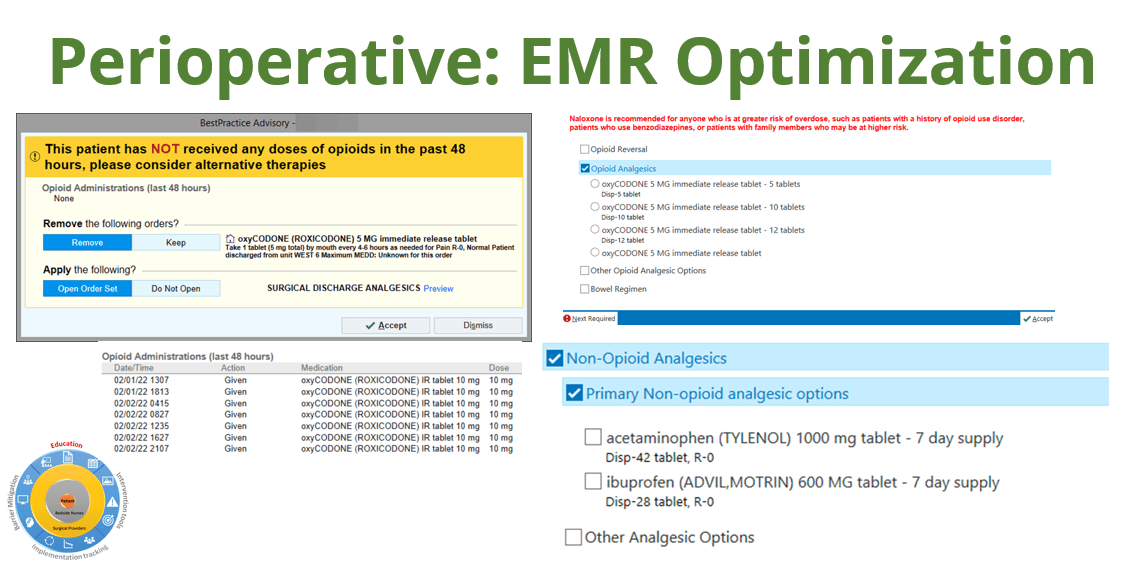
Electronic medical record (EMR) optimization: Order set (best practice advisory (BPA) displays final 48 hours opioid use, reminder if no opioids used)³
Procedure-specific ranged maximum recommendation chart (ID prescribing badges, wall clings, QR code)
Infographic (wall clings) to help lead discussion regarding postoperative pain management after surgery
Bedside nurses
Infographic (wall clings) to help lead discussion regarding postoperative pain management after surgery
3. Tools to track implementation
Patient/surrogate
Qualtrics surveys for wall clings and Deterra bags
Care team
Residents/APPs
Tableau dashboard
Faculty
Tableau dashboard
4. Acknowledging barriers
Adapting EMR to fit needs
Facilitating culture change
Learn more about postoperative pain management on our resource page.
Questions? Connect with Program Assistance.
Notes
¹ These recommendations are based on the Michigan OPEN guidelines as well as the input of our surgeons and medical leadership based on regional data to establish clinically appropriate guideline commendations.
² In addition to Tableau, we are able to provide templates/guidance on other data visualization tools.
³ EMR optimization includes several advisory messages as well as integrated functionalities. This includes data on the last 48 hours of opioid administration for each patient and an alert to indicate when a patient has not been given any opioids in the last 48 hours prior to discharge and encourages alternative therapies. There is an additional option for selection of primary non-opioid analgesics, and there is also a recommendation for prescribing naloxone for patients who may be at greater risk of overdose within this order set.
